

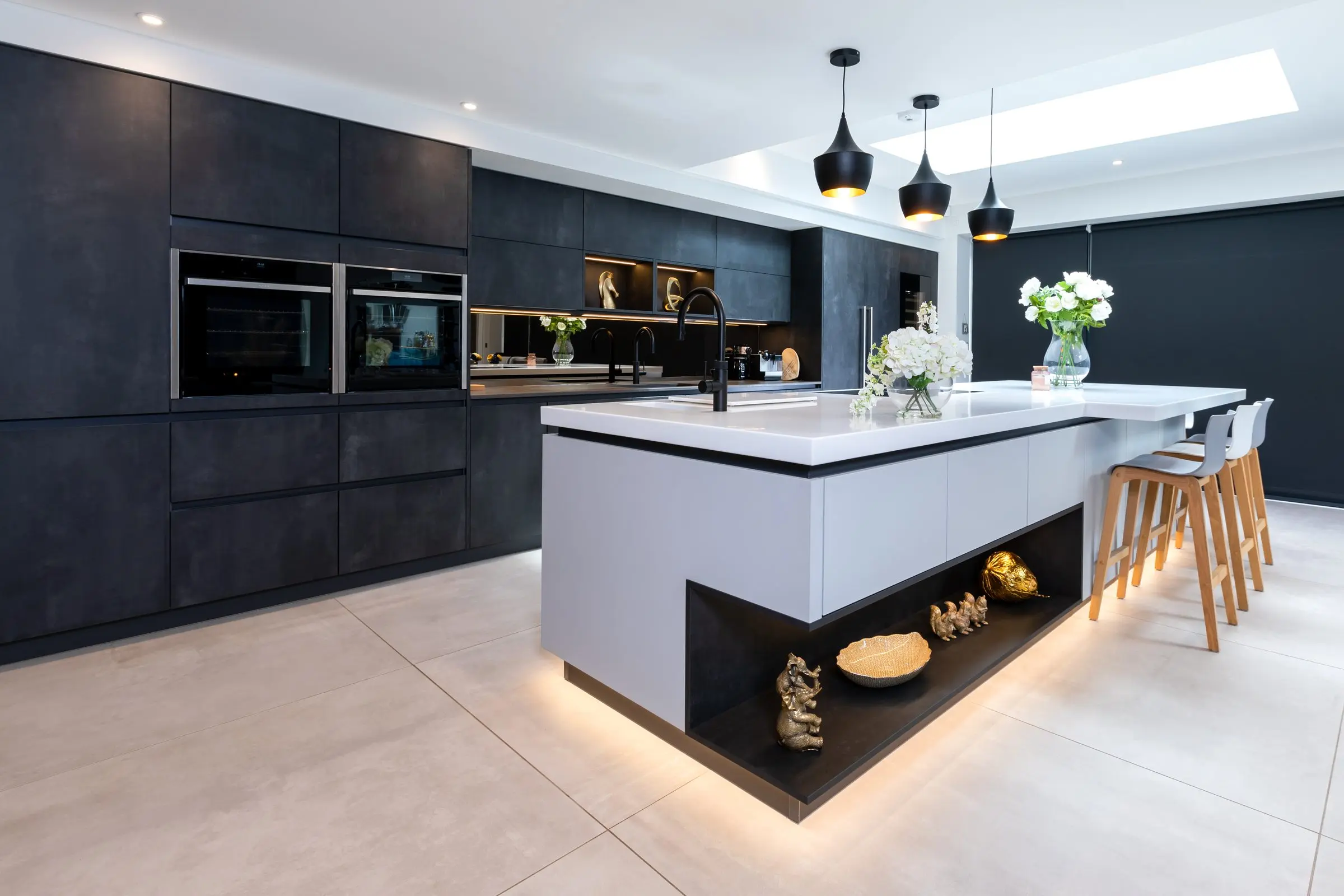
Straight answers to the questions we hear most.
Kitchen FAQs: cost, design, installation and aftercare
Cost and budget
Download the pricing guideHow much does a Suga kitchen cost?
It depends on the size of the room, the cabinetry and the appliances you choose. Our pricing guide shows real project costs at three levels of specification, so you can set a realistic budget. For a figure for your own kitchen, book a free design appointment.
What’s included in your quote?
Your quote covers the design, the cabinetry, worktops and appliances you've chosen, and installation by our fitters. We normally look after the whole project apart from decorating, and if you'd rather install the kitchen yourself, we can supply it only. Our guide to what's included in a bespoke kitchen quote explains what to check when you compare quotes from different companies.
Should I tell my designer what I want to spend?
Yes, please do. Knowing your budget early lets your designer choose the brand, finishes and appliances that get the most from it, rather than drawing something you then have to strip back. It's a normal part of the conversation and nobody will push you past it. Our guide to budgeting for a kitchen renovation has more on setting a realistic figure.
How much of the budget goes on appliances?
As a rough guide, appliances often take around a quarter of the total, but it varies a lot with what you choose. A venting hob or a boiling-water tap changes the sums quickly. Our pricing guide breaks real Suga kitchens down into cabinetry, appliances and worktops at three levels of specification, so you can see where the money goes.
Why do German kitchens cost more?
Much of the difference is inside the cabinets. Our Schüller and next125 kitchens are built from 19mm boards with laser-sealed edges that keep moisture out, they hang on Blum hinges tested to 200,000 openings, and they're made to order to your measurements. Our guide to what a German kitchen costs in 2026 explains where the money goes.
What happens at a design appointment?
You'll meet one of our designers in the showroom or at home, talk through how you use your kitchen and what you'd like to change, and look at layouts, doors and worktops. It's free, there's no obligation, and you'll leave with a clear idea of the next step.
What should I bring to my first appointment?
Anything that helps us understand the room and how you use it: photos of your current kitchen, rough measurements if you have them, any drawings from your architect, and pictures of kitchens you like. A rough budget helps too. If you have none of these, that's fine, because your designer will measure the room properly later.
Can I make changes to my design?
Yes. Changing your mind is part of designing a kitchen, and it's far cheaper to move a cupboard on a drawing than once things are ordered. One client told us Lindsay was really patient when they kept changing their minds about colours and finishes. Up to three rounds of changes are included before you sign off the final design. Our guide to design revisions explains what to expect.
Do you design kitchens for period homes?
Yes. Older houses can have walls that aren't straight, floors that aren't level and services in awkward places, which is exactly what our 40-point check is there to find before anything is ordered. If you'd like a painted, traditional look, Suga Handmade in-frame cabinetry is built to the exact measurements of your room. German cabinetry can suit a period house too, especially in an extension.
When should I bring a kitchen designer into my extension?
At concept stage, before the planning and building regulations drawings are finished. That's when the position of the kitchen, the services and even the windows can still change easily. We can then give your architect a services overlay drawing and a zoning brief, and visit at first fix to check everything is where the design needs it.
Can you design a kosher kitchen?
Yes. We've designed a kosher kitchen in Prestwich with guidance from the clients' rabbi, with two sinks, two dishwashers, appliances with a Sabbath mode and non-porous worktops. Every household keeps kosher in its own way, so we start by asking how you keep yours and plan the layout, storage and appliances around it.
Survey and installation
See how our process worksWhy do you survey my kitchen twice?
Your designer measures the room to create your design. Then, before anything is ordered, Danil visits with a fresh pair of eyes and a 40-point check. He spent years installing kitchens and is a certified electrician, so he looks for what causes trouble on fitting day, such as uneven walls and floors, awkward access and services in the wrong place. Anything he finds is fixed on the drawings.
How long does a site survey take?
Danil's survey usually takes one to two hours, and it's included in the design service. We check how straight the walls are, the floor levels and ceiling heights, and where the plumbing, electrics, ventilation and gas are. If you're having building work done, the survey happens at first fix, once the services are in.
How long does it take from design to installation?
Most kitchens are installed 8 to 14 weeks after you sign off the final design, depending on the brand. Once you've signed off, you'll get a written schedule, and we'll call a week before installation to confirm the details.
Who will install my kitchen?
Our fitters, a small team who have worked with us for more than 20 years. They work to a written schedule, and your fitter is your point of contact on site, keeping you updated and leaving the room tidy at the end of each day. Clients often mention their fitter by name in their reviews.
Will you work with my architect and builder?
Yes, and the earlier the better. We'll give your architect a services brief and a drawing showing where the kitchen needs its plumbing, power and extraction, and visit at first fix to check everything is in the right place before the walls are finished. Danil can also introduce you to trades he trusts, such as stonemasons, roofers and painters.
Aftercare and guarantees
Read the Suga PromiseWhat guarantees come with a Suga kitchen?
Every kitchen we install comes with a 5-year workmanship guarantee, and the stone worktops we supply carry a 10-year guarantee. Your appliances have their manufacturers' own guarantees, of up to 10 years depending on the brand and model. We also come back for a check-up visit 12 months after handover. Both of our guarantees are given in writing.
What if something isn’t right after installation?
Tell us. A week or two after installation, we come back for a snagging walkthrough with you. Anything that isn't right goes on a written list, with a confirmed timeframe for putting it right. If something comes up after that, call us on 0161 962 7261.
What does “KBSA Approved Member” mean?
The KBSA is the trade association for kitchen, bathroom and bedroom specialists. Approved Members have met its standards, and as our client you have access to its complaints and dispute process if something goes wrong and we can't put it right between us. You can check our membership on the KBSA website.
Can you get replacement parts years later?
Usually, yes. We've re-ordered replacement components for kitchens we fitted several years earlier, and for Schüller kitchens replacement doors are generally still available after ten years. Call us with the details and we'll find out what's possible for yours.
Who do I call if I need help after my kitchen is fitted?
Call the showroom on 0161 962 7261 and you'll speak to the team who designed and installed your kitchen. If something isn't right, just give us a call.
Showroom and appointments
Plan your visitDo I need an appointment to visit the showroom?
No, but we'd recommend booking. Booking ahead means a member of the team will be free to show you round and answer your questions properly. If you'd like time with a designer to talk about your own kitchen, book a free design appointment instead.
When is the showroom open?
We're open Monday to Friday, 9am to 5pm, and Saturday, 10am to 4pm, and closed on Sundays. Booking ahead is recommended, so a member of the team is free when you arrive.
What can I see in the showroom?
Kitchen displays from Keller, next125 and Schüller, door samples, and working appliances you can see in action, including NEFF products you won't find on the high street. You can open the drawers, feel the finishes and compare the brands side by side.
Can I see the showroom before I visit?
Yes. Our 3D virtual tour lets you walk round the showroom from home, moving between the displays and getting close to the finishes, before you decide to come in.
Which areas do you cover?
Most of our clients live within half an hour of our Altrincham showroom, including Hale, Manchester, Knutsford, Wilmslow, Bramhall, Alderley Edge and the wider Cheshire area. If you're further afield, give us a call and we'll tell you honestly whether we can help.
Brands and materials
Download our brochureWhat’s the difference between Schüller, next125 and Keller?
Schüller is a family-owned German brand with the widest choice of doors and finishes. next125 is its design-led sister brand, made in the same factory, using materials such as ultra-matt lacquer, glass and ceramic. Keller is made to order in the Netherlands and is best known for calm, matt slab doors. Our brand guide compares all three in detail.
Is next125 the same as Schüller?
They're made in the same Bavarian factory, with the same 19mm boards and Blum hardware, but next125 is Schüller's design-led sister brand. It has a smaller, more curated range built around ultra-matt lacquer, glass, ceramic and real wood veneer, and it usually costs more than an equivalent Schüller kitchen. Our article on what makes next125 different explains more.
Is Keller a German kitchen?
No, Keller kitchens are made to order in the Netherlands. Keller is best known for calm, matt slab doors in muted, earthy tones, and its kitchens have been produced carbon neutrally since 2017. Our business started out as Keller Kitchen Centre in 1986, and we're still a registered Keller dealer.
Should I choose a German kitchen or a handmade one?
It mostly comes down to the look you want and the house you live in. German cabinetry suits clean, modern designs and gives you a huge choice of finishes. Handmade in-frame cabinetry suits period homes and anyone who wants a painted, traditional kitchen built to the exact measurements of the room. Your designer can show you both in the showroom.
Who makes Suga Handmade kitchens?
Suga Handmade is our own range, handmade by joiners in Manchester. The cabinetry is dovetail-jointed, hand-painted and built to the exact measurements of your room, so it suits period homes and traditional in-frame designs especially well. FSC certification can be confirmed for the timber used in your kitchen.
How long will a German kitchen last?
Schüller specifies a minimum 25-year working life for its cabinets, and the Blum hinges we use are tested to 200,000 openings. How long a kitchen lasts also depends on how well it's installed, which is why every Suga kitchen is surveyed twice before anything is ordered.
Which worktops do you offer?
We fit a wide range, including Silestone and Dekton from Cosentino, quartz, ceramic and solid surfaces such as Corian. Each behaves differently with heat, stains and knives, so your designer will talk you through what suits the way you cook. Stone worktops we supply come with a 10-year guarantee. Our guide to choosing a worktop material lists the questions worth asking.
Didn't find your answer?
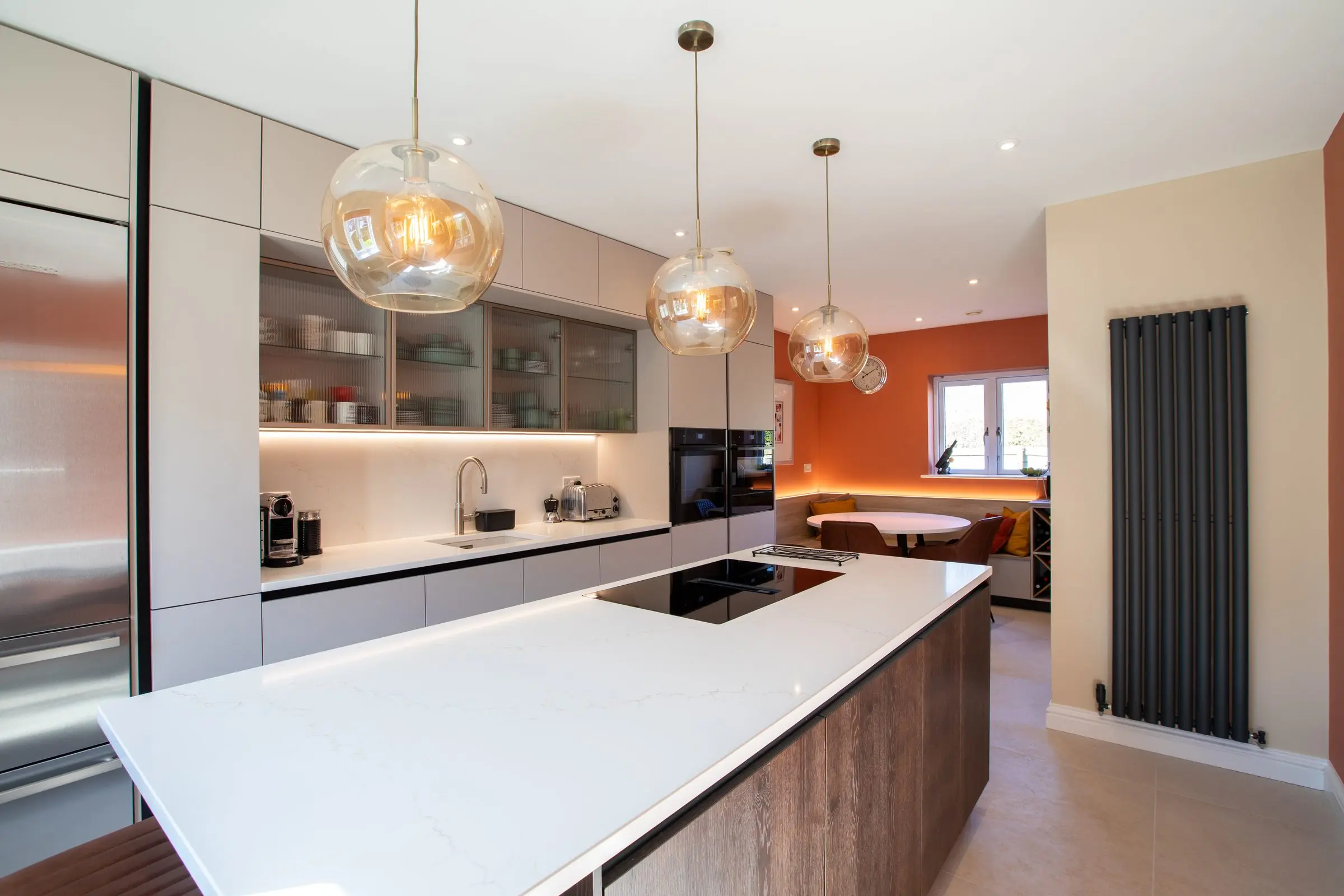
Ask us. A quick call with a designer is often the fastest way to get a straight answer about your own kitchen, whether it's about budget, timing or whether a layout will work. If you'd rather read up first, our kitchen guides go into much more detail on costs, lead times, surveys, extensions and aftercare, many of them written by Danil and Cass.
Start whenever you're ready
Pick whichever suits you best. Whichever you choose, you'll be speaking to a designer who can answer your questions properly.
Book a free design appointment
Meet a designer, talk through your ideas and get a quote for your own kitchen. Choose a time → 02Download the pricing guide
See what Suga kitchens cost before you speak to anyone. Get the guide → 03Request a call back
A quick chat with a designer at a time that suits you. Pick a time → 04Visit the showroom
See the kitchens in person, or take the virtual tour from home. Plan your visit →Or call 0161 962 7261